Keeping It Fresh: How the Food Industry Can Secure Cold Chain Stability
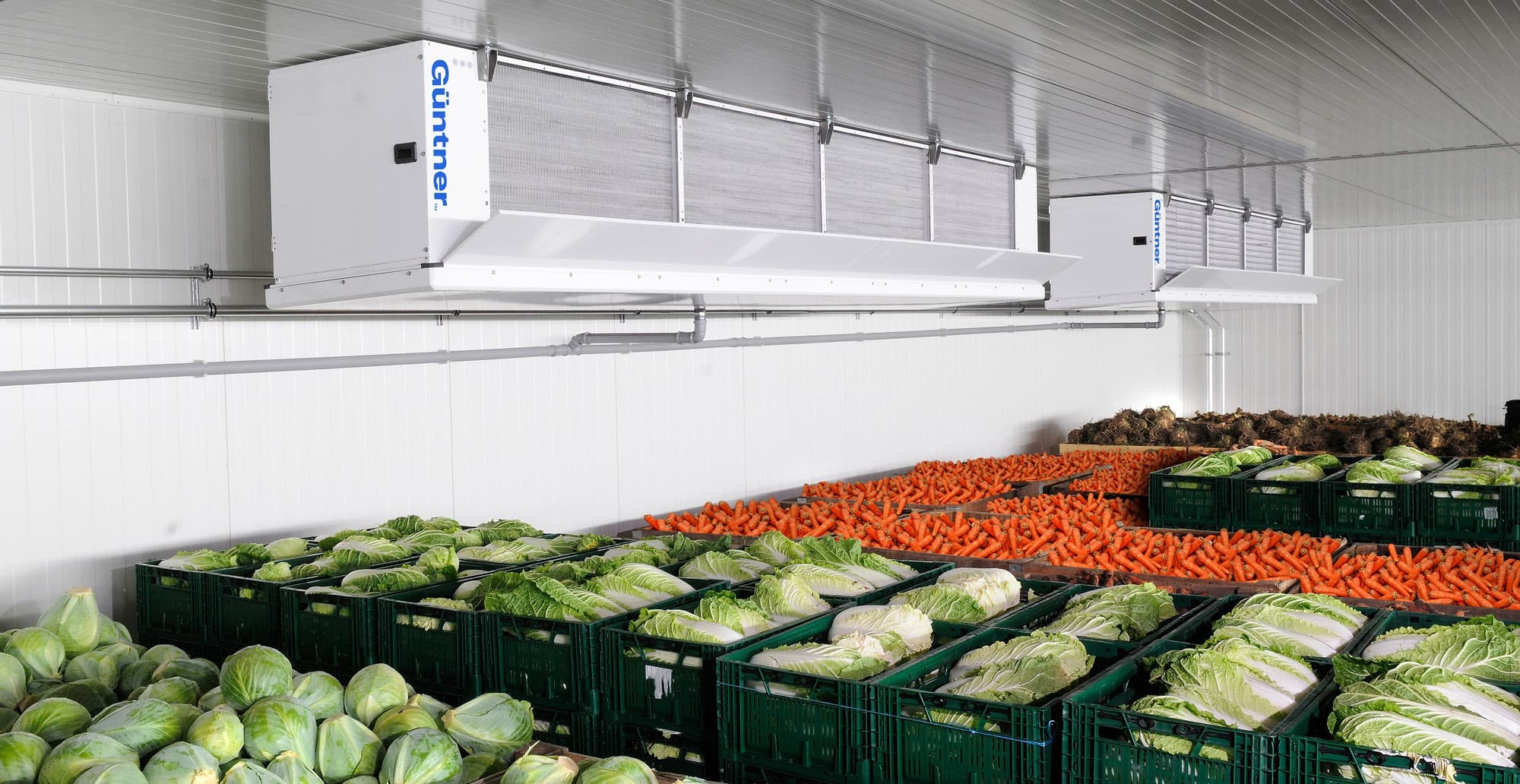
In food manufacturing and logistics, ensuring consistent product quality and food safety starts with one critical factor: a stable and uninterrupted cold chain. From farm to fork, even a short break in cold chain temperature for food can lead to spoilage, food waste, health risks and loss of consumer trust. For food manufacturers, cold storage operators and logistics managers, the challenge is clear: ensure optimal cold chain management in the food industry – 24/7, across all stages.
This article explores how engineering foresight, digital monitoring and modular systems can make a measurable difference. It also highlights how we support customers with energy-efficient refrigeration systems and deep industry expertise.
Why Cold Chain Stability Matters in Food Manufacturing
In the food sector, temperature-sensitive goods require exact cooling parameters to guarantee freshness, safety and shelf life. A failure in the cold chain for food can compromise product integrity long before it reaches the customer.
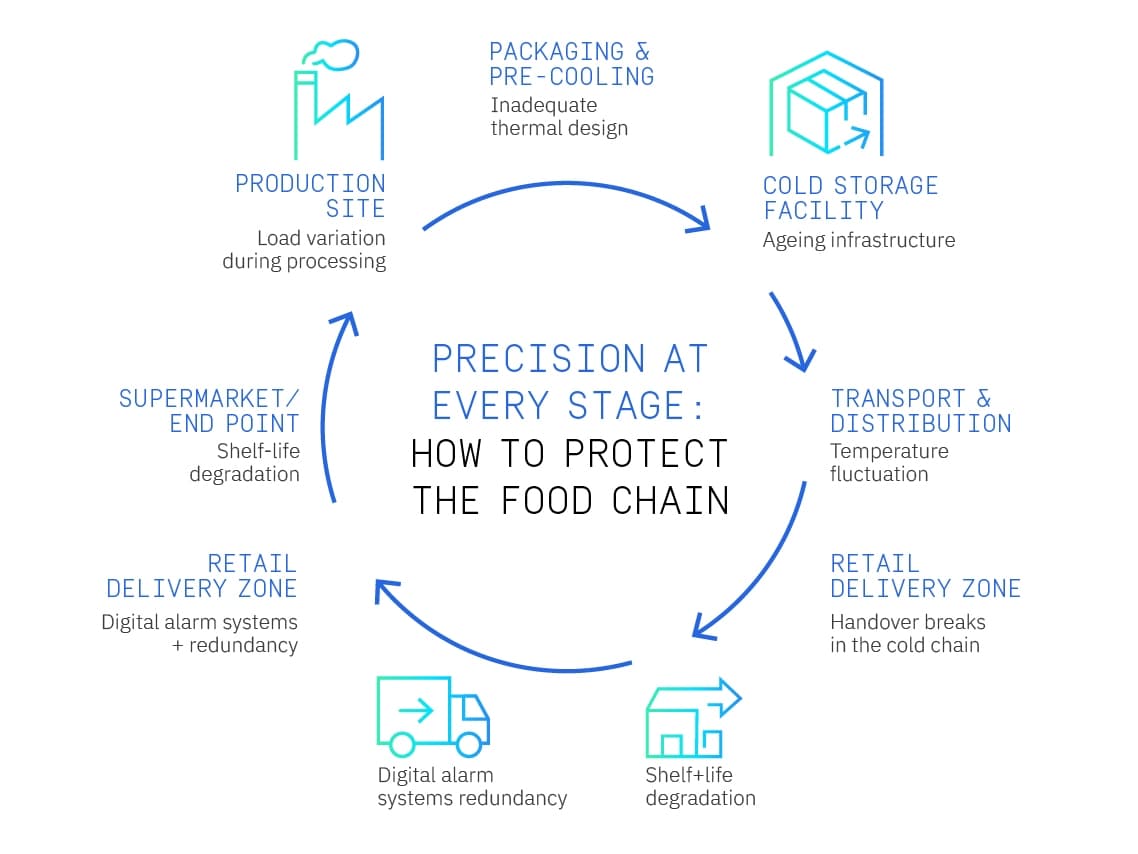
Typical cold chain challenges:
- Load variations during production or packaging
- Inconsistent cooling during cross-border transportation
- Ageing infrastructure in warehouses or processing plants
Maintaining temperature stability across the entire cold chain logistics process is therefore not just an operational task – it’s a strategic necessity. Even minor deviations can result in spoilage, product recalls or regulatory violations.
Engineering for Food Safety: Key Design Considerations
Forward-looking cold chain solutions start with engineering. For food production and storage, refrigeration systems must be adaptable, fail-safe and compliant with hygiene and safety standards.
Key planning considerations:
- Redundancy: Dual systems or N+1 designs to ensure uninterrupted operation
- Smart layouting: Zone-based cooling with loop separation for better control
- Load simulation: Design based on production cycles and seasonal shifts
- Modularity: Components that allow easy system expansion or replacement
We provide planning support through powerful digital tools and engineering expertise. Whether you’re designing direct evaporation refrigerant systems or secondary brine circuits, we specify and support both approaches.
With the Güntner Product Calculator on the myGüntner platform, engineers can size and configure condensers, evaporators and air coolers based on real load conditions and low GWP refrigerants. The tool also offers access to product documentation and supports project collaboration – ensuring faster, more accurate system design and seamless integration into modern cold chain operations.
Monitoring the Cold Chain: Transparency in Real Time
Whether in large-scale cold storage or mobile food logistics, temperature must be constantly monitored. Modern cold chain monitoring systems enable real-time data collection and automated alerts.
Benefits include:
- Early detection of anomalies
- Reduced cold chain food waste
- Compliance with documentation and audit requirements
We offer integrated control technologies and digital services to ensure cold chain transparency. With the aicore™ air controller, operators benefit from precise EC fan regulation, real-time monitoring and fail-safe modes. For enhanced control, aicore™ fusion combines EC fan management with hydroBLU™ adiabatic cooling for efficient peak-load handling. Both systems connect to Güntner’s IoT platform, providing centralized insights – crucial in the application of refrigeration in the food industry.
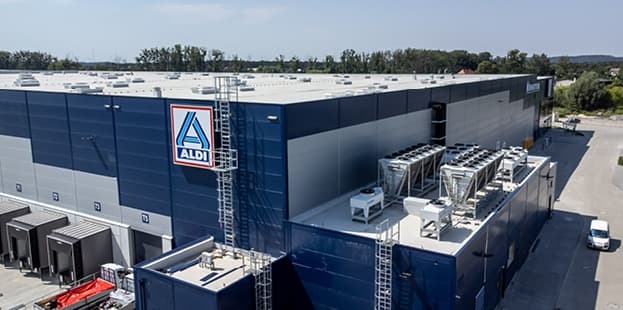
Case Study: Securing Cold Chain Performance for ALDI Nord in Poland
To demonstrate the real-world impact of engineering foresight and technology integration, look no further than ALDI Nord’s logistics centre in Lisi Ogon, Poland. The 43,300 m² facility plays a central role in the retailer’s cold chain for food – distributing chilled and frozen goods to hundreds of stores across the region.
Working with a local engineering partner, ALDI implemented one of Poland’s largest transcritical CO₂ cooling systems. Güntner supplied modular heat exchangers, dual discharge unit coolers, and adiabatic gas coolers fitted with EC fans – each engineered to maintain precise cold chain temperatures for food, even during summer heatwaves.
What makes this project stand out is its seamless combination of energy-efficient refrigeration systems, digital controls, and natural refrigerants. The system was stress-tested at 38 °C ambient temperature and performed reliably without deviations – ensuring food safety and long-term system stability.
Notable results:
- Improved energy performance through demand-based cooling and adiabatic precooling
- Enhanced product freshness and food waste reduction across the delivery chain
- A scalable solution ready to serve up to 250 ALDI stores with uninterrupted cooling

LET’S TACKLE YOUR COOLING CHALLENGES TOGETHER
Behind every great cooling solution lies a deep understanding of your specific requirements, industry and application. Therefore, every solution starts with a conversation.
Cold Chain Monitoring in Food Logistics: What Matters Most
Food Packaging and Cold Chain Efficiency
The interface between packaging and cold chain food packaging is often overlooked. Poor thermal design or wrong material choices can negate the benefits of high-performing refrigeration systems.
Important considerations:
- Use of phase-change materials or vacuum-insulated panels
- Packaging formats that match cooling profiles
- Traceability integration with packaging for quality control
Refrigeration alone cannot ensure freshness – it must work in sync with packaging strategies.
How Güntner Supports the Food Industry
We combine cold chain technologies, consulting and compliant engineering. This includes:
- Modular heat exchangers and evaporators optimised for food logistics
- Systems that support natural refrigerants like CO₂
- Tailored control systems and digital monitoring dashboards
Whether it’s designing a new facility or upgrading existing infrastructure, we help reduce food waste, improve energy performance and ensure long-term regulatory compliance. Each solution is tailored to the customer's operational needs—scalable, efficient, and built to perform in the toughest environments.
Let’s Talk Cold Chain – for Food that Stays Fresh
For food manufacturers, cold chain management is more than logistics – it’s a mission-critical discipline that impacts product safety, compliance, and profitability. Rising energy costs, stricter sustainability goals and evolving consumer expectations make reliable, energy-efficient cooling systems a strategic priority.
We combine proven cold chain technologies, regulatory know-how, and tailored consulting to help food businesses design systems that are robust, scalable and compliant. From first concept to commissioning, our experts are here to ensure your cold chain stays strong – every step of the way.
Let’s Talk Cold Chain – Our Experts Are Ready to Support Your Next Project!
LET’S TACKLE YOUR COOLING CHALLENGES TOGETHER
Behind every great cooling solution lies a deep understanding of your specific requirements, industry and application. Therefore, every solution starts with a conversation.