Stable Cold Chains in Industrial Refrigeration: Why Planning and Safety Are Crucial
In the field of industrial refrigeration systems, few things are as vital as a stable and uninterrupted cold chain. Whether it’s food logistics, pharmaceuticals, or temperature-sensitive industrial processes, even a brief interruption in the cooling system can lead to product losses, safety risks, and compliance issues. For plant engineers, the solution lies in forward-looking design: reliable, scalable, and fail-safe systems from the ground up.
This article highlights key planning and safety considerations for engineers working on commercial refrigeration systems – and shows how we support them with expert consulting and energy-efficient cooling technologies.
Planning for Stability: The Foundation of a Reliable Cooling Chain
A stable cooling chain begins long before the system is commissioned. Careful project planning ensures that systems meet current performance needs, account for seasonal fluctuations, and support future expansion.
Critical planning aspects include:
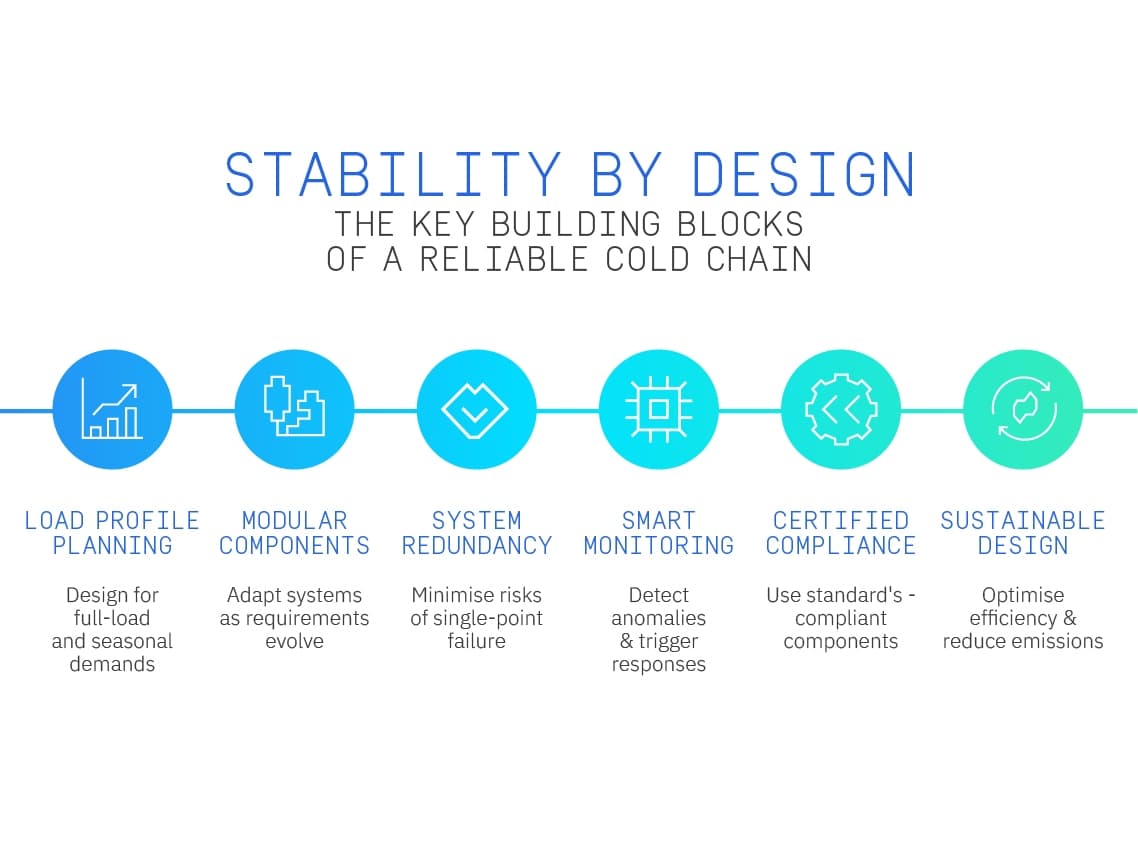
- Load profile analysis: Designing for peak, partial and transitional loads. In refrigeration for food processing, load variation between production and cleaning cycles must be accounted for.
- Scalability: Modular components ensure future system adaptations without major downtime.
- Component matching: Compressors, evaporators, condensers and control units must be precisely coordinated to optimise performance.
- Digital tools: Software like the Güntner Product Calculator on myGüntner helps engineers simulate operational scenarios and choose ideal components.
We provide support from the start with expert guidance and technical data that can be integrated into digital planning workflows – minimising delays and ensuring compatibility across the cooling system components.

LET’S TACKLE YOUR COOLING CHALLENGES TOGETHER
Behind every great cooling solution lies a deep understanding of your specific requirements, industry and application. Therefore, every solution starts with a conversation.
Redundancy and Safety in Cooling System Design
In cold chain logistics, redundancy isn’t optional – it’s essential. In industries like cold chain supply logistics and high-volume distribution, downtime translates to financial and operational risks.
Key redundancy strategies:
- N+1 system redundancy: Ensures spare capacity in case of equipment failure.
- Split systems & loop separation: Isolate individual zones to contain issues.
- Smart monitoring: Detect issues before they cause downtime.
Our technologies – such as Güntner Motor Management (GMM) – enable demand-based fan regulation, remote monitoring, and alerting mechanisms. These features enhance uptime while supporting refrigeration energy savings.
Cold Chain Compliance: Regulations and Engineering Standards
Industrial cooling systems across Europe must meet stringent safety and environmental standards. From F-gas regulations to hygiene and construction directives, compliance is critical.
Engineers must ensure:
- Use of CE-certified components with DIN/EN/ISO conformity
- Compliance with natural refrigerant standards (e.g. CO₂, NH₃)
- Documentation and validation for inspections and audits
Our products are certified to global standards like ISO 9001, UL and GOST. Plus, its documentation and compliance support simplify approvals for engineers and end users alike.
Case Study: Cold Chain Stability for Aldi Nord in Poland
In Lisi Ogon, Poland, Aldi Nord built a 43,000 m² distribution centre requiring consistent performance across multiple cold zones. A local engineering firm partnered with usr to deliver a future-proof solution.
The design included:
- A CO₂-based industrial refrigeration system for medium and low temperatures
- Güntner Flat COMPACT Condensers and dual discharge unit coolers, optimised for CO₂
- EC fans with adaptive controls to reduce energy consumption
- A focus on energy-efficient refrigeration systems that suit both Polish climate conditions and EU directives
The outcome: A highly efficient system with full cold chain stability, lower environmental impact, and measurable operational savings. The demand-driven operation significantly reduced energy use during seasonal peaks, while the use of natural refrigerants ensured long-term regulatory compliance and environmental responsibility.
Stability by Design – The Key Building Blocks of a Reliable Cold Chain
Modular Solutions and Consulting Expertise from Güntner
One of Güntner’s core strengths lies in its modular product approach: heat exchangers, condensers and evaporators come in a range of sizes and capacities, yet are built on standardised platform technologies.
This enables:
- Faster delivery due to standardised production
- Easy upgrades or replacements in the field
- Seamless integration into customer-specific system architectures
Alongside the hardware, we support system planners with experienced engineering teams. They advise on selecting the right components, refrigerants and control strategies – ensuring optimal system performance, energy efficiency and full regulatory compliance from the outset.
Let’s Talk Cold Chain Engineering
Cold chain management is a mission-critical discipline – especially for those designing infrastructure for logistics, production or retail. With energy prices rising and sustainability targets tightening, engineers need future-proof solutions now.
We combine sustainable cooling technologies, regulatory expertise, and energy-efficient cooling systems to help engineering teams succeed – from first concept to final commissioning. This ensures that every system is built for long-term performance, compliance, and cold chain stability.
Let’s Talk Cold Chain – Our Experts Are Ready to Support Your Next Project!
LET’S TACKLE YOUR COOLING CHALLENGES TOGETHER
Behind every great cooling solution lies a deep understanding of your specific requirements, industry and application. Therefore, every solution starts with a conversation.